After sanding off drips and problems from the first coat, I spent another few hours finishing up the second coat.
It was even hotter this day than the last, and it was as painstaking as ever. But, the large scale staining is now over, so off to bigger and better things!
I will be updating this blog regularly with information about my English WISE project.
Monday, June 16, 2014
Tuesday, May 27, 2014
Making Biscuit Slits
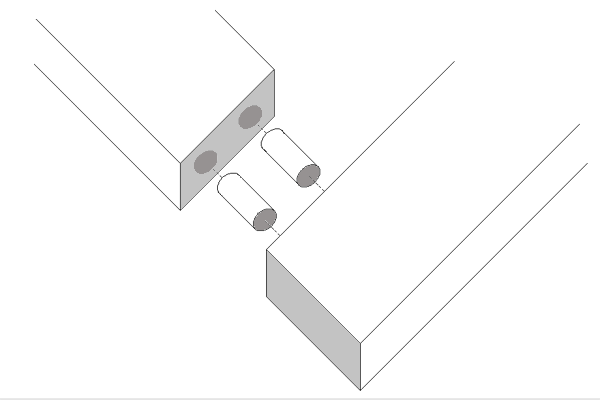
The biscuit slits were actually really easy to make with this specialized too. Since the side panels are about 1 1/2 inches thick, the cutter was set up at precisely 3/4 of an inch.
The end result was perfect, except for a few issues in the leg... After the cuts were made I connected the newly formed slits together with small football shaped pieces of wood. The connections were great, and as far as I can tell there are absolutely no errors.
Specialized tool for creating biscuits.
The end result was perfect, except for a few issues in the leg... After the cuts were made I connected the newly formed slits together with small football shaped pieces of wood. The connections were great, and as far as I can tell there are absolutely no errors.
Sunday, May 25, 2014
Finished Mortise Hole
The process of drilling the holes in all four legs went very smoothly. Not a single mistake on these, with each marked out before hand as to where to drill is to enter so there is a smaller margin of error compared to other methods.
Even without tools or looking to closely, one can tell that the hole for each leg is slightly off center. The tenon of the side stringer, when through the mortise, will line up so that the hole drilled into the tenon is basically centered in the leg for more stability in this connection.
There may have been no problems while drilling into the legs, but many had occurred when it was time to create the peg holes in the tenons. For example, the first two I drilled I had not pushed the tenons into place correctly, so the drilling points were wrong and ended up not pulling the tenons in, or even matching up at all. This created a huge problem, and so we ended up cutting a bit of the 1/4 inch peg the width of the tenon and gluing it into the newly made holes so that the area could be reused.
Even without tools or looking to closely, one can tell that the hole for each leg is slightly off center. The tenon of the side stringer, when through the mortise, will line up so that the hole drilled into the tenon is basically centered in the leg for more stability in this connection.
There may have been no problems while drilling into the legs, but many had occurred when it was time to create the peg holes in the tenons. For example, the first two I drilled I had not pushed the tenons into place correctly, so the drilling points were wrong and ended up not pulling the tenons in, or even matching up at all. This created a huge problem, and so we ended up cutting a bit of the 1/4 inch peg the width of the tenon and gluing it into the newly made holes so that the area could be reused.
Friday, May 23, 2014
Setting Up for Drilling of the Legs
With a shorter tenon for the side stringers causes the issue of not being able to drive wedges into mortises at the ends of each. The solution: small quarter inch wooden pegs that can be driven into holes in the hole of the leg perpendicular to the entrance of the mortise. Another hole will be put 1/32nd of an inch to the further out area in the tenon to pull it tightly and erase any possibilities of instability.
This is the quarter inch drill bit that will be used to drill out the hole in both the leg and the tenon. There is scotch tape about an inch and a half up to prevent drilling through the leg as the point is to keep the 1/4 inch wooden peg in as tight as possible with few exits.
Wednesday, May 21, 2014
Staining Reflection
Staining with polyurethane turned out to be a much different experience compared to simply painting one's room or using compressed air to paint small objects. It required a lot of patience and precision, especially with the legs and stringers as they are very thin and the stain should not go near the edges to prevent dripping. As all of the objects painted during the first coat session had four sides that needed to be stained, two saw-horses were set up to keep the surfaces touching to a minimum. I put a layer on the top side, then I would rotate the piece to the right and finish the next side for each to keep a consistent pattern. To dry without any errors, such as marks from a surface touching the fresh areas, there needed to be about a 2 hour interval between painting the first two sides, and the last two sides of each piece. So, of course, we went to lunch then finished up in the afternoon. After finishing each piece of wood, they need to be sanded to rid of any extra dust or drips. The plan for our next session is exactly that; sand, stain the second coat, and hope for the best.
Tuesday, May 20, 2014
Finishing the First Coat
The process of staining the first coat was really fun, but at the same time absolutely horrible. Everything had to be done perfectly, and I could only do two sides of each piece at a time so that it could dry before being placed on a surface. The problem with doing only two sides and then waiting for it to dry is that it takes around 2 hours to dry, and sides would tend to drip as they were perpendicular from the level ground.
The final look of the first coat is really beautiful, it turned a much darker brown than the original reddish chocolate color. It took around 6 hours give or take to finish painting all of these pieces, and that was entirely in a stuffy controlled environment which made things more uncomfortable.
Monday, May 19, 2014
Painstaking Staining
Over the past weekend I stained, or painted, the first coat for all of the piece of the desk. The best method to stain walnut wood is to use clear satin polyeurathane and use long strokes. Since staining the finished pieces is very risky business, the process had to be very slow and precise to make sure there is no dripping and no puddles.
The first part of the coating. I started on the easiest piece, the side panel. There aren't any mortises in the way, or tenons to avoids. It went well for the most part with minor dripping on each side. My plan for the next few pieces is to put as little substance on my brush at a time as I can to try and avoid any dripping or excess.
Wednesday, May 14, 2014
Fitting and Wedges
The legs and supports so far that are sanded and cut to perfection have now been assembled! The look is fantastic even unfinished, all that is missing now is the side panels and two of the longer supports (these need to have the tenons cut again, and sanded of course).
To keep the supports in place, a smaller mortise has been cut into the tenons on the longer supports. Small wedges will be added, but since the mortises are all different sizes and they also stick out at different lengths, the time that will be needed to create the wedges to fit perfectly will be quite a lot.
Monday, May 12, 2014
Sanding and Cutting Tenons
For a few hours of work yesterday (Sunday May 11th) I had to cut the tenons on the ends of the top supports to easily flush with the top of the legs and side panels to allow the top to fit without any movement or issues. Along with creating flush tenons, the tenons also had to be sanded to fit perfectly into the mortises. This was a grueling exercise, for it took hours to make the tenons fit correctly, or at least it seemed.
I'm really happy with the end results. At this point every piece is cut and sanded together, and I'll assemble everything to make sure the desk holds up. There's a ton of more work to do, but pretty soon I'll get to the finishing portion of the project (painting and more sanding. Yay!). This is the only part of the project that is bothersome so far, as sanding is extremely tiring.
Friday, May 9, 2014
Upcoming Weekend Plans
This weekend I'm planning on going to my grandfathers to work on the legs mostly. The unfinished portions are the length of the legs, the height of the tenons, sanding and finishing of almost all of the wood, and putting biscuits on the sides of the side panels (aprons) to easily attach to the legs. Since the inventor design now needs an IDW file, I can create that in the near future (dimensioning is quite time consuming).
Hopefully the door I acquired will be usable, although I'm suspecting since it cannot be nicely cut due to a hallow interior I'm going to need to stick to the 3 layer idea. This is whiteboard on top, and two layers of MDF underneath, one smaller than the other, and walnut on the edges to create a stylish look. The MDF will be made slightly smaller so that it can fit into the frame and the top section will overhang to create a tabletop look.
Tuesday, May 6, 2014
A Door for the Top
I went to Serene Elements, an antique shop after school. I went looking for an old door to use as the top of my desk, as they are extremely sturdy and already made to be a mostly correct size (except for the length, which is about double my intentions). I went in and the manager greeted me, saying the store was closed but if there was anything I needed specifically. I explained I needed a door without any details, like indents or fancy engravings. I'm assuming this question had been asked previously, as he immidiately went to "oh, for a desk?". He led me to the back, and there were about 5 doors. Most of them were quite beat up as they were scrapped from old buildings.
I had to choose between a lamenated, in my opinion prettier door, and a plain reddish maple textured door. I felt that even though the lamenated option looked better, glueing and working with it would be a pain. In the end I took the red maple door, and I have high hopes for this piece. With my updated design I recently uploaded, I can easily attach a piece of plywood to the bottom so it can slide into place.
Monday, May 5, 2014
Desk Redesign
After some building and talking about my previous design with my grandfather, we came to the conclusion that the top needed to be attached a different way. This would include a drop down into the new frame, which now contains new support beams and side panels. The top will be made of a slice of a door for the very top portion, and a plywood 2 inches less in width and length that can drop into the frame..
Wednesday, April 30, 2014
Side Panels
The other portions of the desk that I could have made with the available resources were the side panels. They are basically shorter, much wider an sturdier supports. These are a part of the new design, and the sides will consist of the 10 inch tall side panels and a thinner two inch normal support with tenons under the panels.
The side panels will attach to the legs with what my grandfather calls "biscuits". I will create a more detailed post about them in the future as the idea is hard to understand and even I need a better understanding of them.
Tuesday, April 29, 2014
Recent Building Reflection
Over spring break I met with my grandfather for about 20-25 hours worth of work. It started on the cold Tuesday morning, with the first work being bringing wood over to his work shop and smoothing the boards. The legs were made out of a much shorter, thicker board, while all of the supports and side panels were made from a much thinner board. Drilling the mortises is a problem currently, as the square chisel kept sliding up the press. Eventually we drilled out the mortises and next time we meet we plan to use the square chisel and manually carve out the correct area.
On the day after, Wednesday, I spent most of the day chipping away for the tenons with 5 circular saws. The tenons are 5 inches long and about an inch thick, which is still quite a sturdy amount and will be used to slide into every mortise.
Monday, April 28, 2014
Milling the Tenons
Along with creating the mortises in the legs, I had to create the tenons on the ends of the supports so that the pieces could fit together. Five saw blades were set up on the tablesaw so that the correct amount of wood could easily be taken away.
So far this has been the most fun part of the project, especially because it included the most amount of hands-on time. A problem with using this method, however, is after the blade is run through from one side and comes out to the other, the wood will chip and split and ruin the sides. This isn't too large of an issue, mainly because these pieces will not be too visible since they will be touching the table top and are almost completely out of view.
I'm quite proud of how the end results came out, the length of the eight tenons is about +/- 1/16th of an inch, which is an all right margin of error.
Thursday, April 24, 2014
The Mortise and Tenon in Action
The entire frame and legs is held together with the Mortise and Tenon joint. Since yesterday, Tuesday, we spent the entire day working on smoothing the wood, today will be dedicated to cutting the frame to length, them trimming portions to demonstrate the correct making of the Mortise and Tenon. My grandfather found in his cabinet a contraption to set up on his drill press of a Mortise maker. I forgot to take a picture of it, but basically it is a drill with a similar sized square chisel slightly higher than the tip of the drill. However, the square chisel kept sliding up, so in the end we decided to create holes and chisel out the remaining portion by hand.
The holes came out to be in the correct place for each, other than the leg on the far left. Accidentally, the holes were drilled too far down the leg, and created a length of longer than the height of the back supports which we intended to link with. The problem now is that the areas will no longer flush. Thankfully, though, there is about 40 inches of wood, and we only need about 30. This is useful for redoing the leg in the future if we are unable to attach the support.
Wednesday, April 23, 2014
Smoothing and Initial Cutting
Because the lumbar we started with is rough, we sent the board through the milling machine to cut off a very small amount from the edges to create an even, smooth surface.
As one can see from the top of the wood, the surface is incredibly rough. It was hard to get the height of the mill correct, as we had to keep adjusting as it went through to cut the amount we wanted.
The finished piece came out looking really amazing!
I was amazed at the difference the milling had created. The previous piece of wood would give splinters from simply running my hands down it. The second felt as if I could slide across it in my bare feet without any worries.
Tuesday, April 22, 2014
Construction!
I went to his farm house early this morning, Tuesday April 15th. The moment I got there he simply said to follow him. I thought we would go check out the shop, and he'd give me a rundown how we were going to go about the day. He surprised me by bringing us to the largest barn on his property. Apparently, he's been hoarding all of the wood of a walnut tree for about five years now. His friend from Maryland gave him about 2000 ft boards as long as he shipped it up to Trumansburg.
The amount he has is crazy, and it surprised me a great deal. We'll use one of the boards to create the legs and frame, and in the near future we'll have to find the top. He suggested a whiteboard (similar to a classroom's), which I think is a cool idea.
New Top Possibility
From my grandfather's feedback, I've begun thinking of the suggested way to attach the top. His idea will use the smallest amount of wood possible, as the frame will be small, yet the top still large. According to him, it will be similar to how a tabletop is attached. The top will contain two layers, the top layer will be the nicer looking wood with about a two-five inch overlap of the under layer. The frame will be built to have the under layer nicely slide in, and the top will stop it from going all the way through. This is an incredibly simple yet fantastic design, and as soon as I have time I will draw it up in Inventor.
Friday, April 11, 2014
Date to Begin Work
Spring Break is quickly approaching, which is a time period when a great deal of work needs to get done. I'm really excited to start cutting next week, especially since it'll be in my grandfathers workshop which I've only gone in once before, and I've never used any of the machinery inside. We've planned to meet on the 15th and 16th of April, as it is the only day of break when I'm not working. The freedom in my schedule allows for an entire day of work, and hopefully we'll make the most of the time given. I haven't been able to acquire any wood necessary for building, so I'm assuming we'll make a quick run to a lumbar yard to pick up scraps.
Wednesday, April 9, 2014
Attempting to Reschedule
Since I'm unable to meet with Mr. Cooper on Thursday the 10th, I called him to ask to reschedule. I believe attempting to reschedule had offended him since I called after the meeting time and date, so I will be out of a possible interview with him. I'm really disappointed about this as I was looking forward to seeing his workshop, but it's completely expected as I was disrespectful by asking to move the date after it had already happened. This is definitely something to learn from, and if I plan on interviewing anyone else in my life, I should definitely remember to ask to reschedule BEFORE the date.
Monday, April 7, 2014
Criticism of New Design
After reviewing my topic, my grandfather sent back really helpful feedback.
"TOP
"TOP
Treat the top as a separate piece to be placed on top of a stable frame, just the way a table is made. It can be one thickness of MDF or two. The principal board (the one that shows and is the work surface) should have one side laminated with melamine (It comes that way). If you decide on 2 thicknesses, I have a piece suitable for gluing to the underside of the top. It will be smaller than the top so it will fit inside the frame we are going to build. That means, the INSIDE dimension of the frame should be no longer than 32”. It presently is 34”. The edges of the top piece will be raw, so we will put a strip of walnut around all 4 edges. The edge towards the user will be flush with the work surface and the other 3 sides will extend upwards about ¼” so things won’t slide off. The walnut will look good with the white melamine. The outer dimensions of the top can be determined later or you can design the frame pieces, figure out the final outer dimensions of the frame, and then design the top with about a one inch to two inch overhang all around. The walnut strips will add about ¼” to each dimension.
FRAME
The frame is pretty much as you designed it except it will have a full set of stringers (the long skinny boards) all around the top to stabilize it. I like your use of through-tenons very much, so the longer pieces will pierce the top end of the legs as through-tenons. The left-hand short piece will have to have short tenons because the piece will be on the same level as the through tenons, which will have priority for occupying the legs. The right–hand stringer will be the side of the drawer box. We will attach that in place using biscuits. (I have biscuits and a biscuit joiner.) If you will make your through-tenons a little longer, maybe 3 ½”, there will be room to cut mortises into the portion of the tenon that sticks out, and we can put a wedge through each tenon to secure it in place. That way, you can remove the wedges to disassemble the desk. The top will be attached to the frame with 4 clips and 4 screws, so the top can also be removed when disassembling the desk. Incidentally, don’t build the top until the frame is complete. Then we cut the top to fit the frame. The horizontal stringers on top should be widened to 2 ½” or 3” for increased stability. In fact, all stringers can be widened to the same width.
LEGS
Did anyone ever tell you your legs were a little skinny? A I” square leg is pretty bendy. I would go with 1 5/8” legs. That’s the size of a so-called 2x2. I can show you examples here at the house of various sized legs and you can make a choice. If the thicker legs look too blocky, I would recommend tapering them starting just below the lowest stringer. The taper is on the inside of each leg, not on the outside, so only 2 sides will be tapered."
We're planning to meet over break at some point to discuss the project further. Since I'm quite busy this coming week I'll be unable to do as I hoped, like visiting hardware stores and meeting with Matt Cooper.
From my grandfathers comments, I'm working again on my "Improved Design" to change the attachment of the tabletop and the width of the legs. The problem with changing the width of the legs in CAD is they determine sizes of most of the other lengths of the desk so almost everything will change minorly.
Much Improved Inventor Work
I've almost completely finished my design at this point. There are most likely a few errors I've overlooked, so I just sent the file to my grandfather for his insight.
https://docs.google.com/file/d/0B7_QrtLhHNngeDU3UVNULWxzaFE/edit
The design itself is simple in my eyes, but certain parts about it I truly enjoy. Creating the design in a CAD software may be a more efficient process, but it lacks the joyfulness of drawing with a pencil and ruler.
https://docs.google.com/file/d/0B7_QrtLhHNngeDU3UVNULWxzaFE/edit
The design itself is simple in my eyes, but certain parts about it I truly enjoy. Creating the design in a CAD software may be a more efficient process, but it lacks the joyfulness of drawing with a pencil and ruler.
Contact with Matt Cooper
Over the past few weeks I've been intending to contact Matt Cooper, a local woodworker that has created some amazing pieces of work. Since I'm intrigued in the subject and it would be a good idea for me to get another interview, I called him and attempted to set up a time to come in and talk with him. When he first picked up the phone, he seemed to be pretty busy and said he would call me back. About the same time the next day, he called me and we arranged for me to call him Thursday (4/10/14) morning and remind him I will be coming in and exactly what time I should come in. I'm looking forward to finally meeting him, and I'll soon create some questions that I can ask him.
Tuesday, April 1, 2014
Weekly Reflection and Future Plans
The past week I spent mostly thinking about what I wanted for an end result, and attempting to put it into drawings and models that may possibly work. On the CAD portion of my work, I'm not too sure the back panel will hold up as I'm hoping, as there is a two part mortise and tenon to hold the desk together. The top of my desk so far I've planned to be three planks about 8inches wide each. Currently the look is similar to a park bench, so I'm hoping for wider pieces of wood to work with.
I'm looking into reused wood at Ithaca ReUse located at the triphammer mall. It accepts donations from locals who want to give their past projects, and Ithaca ReUse resells them for a very small price to make profit.
Monday, March 31, 2014
CAD Work
*In future posts I will go more in depth on each part adding technical drawings of each with dimensions.
With my idea fresh in mind, I immediately got to work using a CAD software called Autodesk Inventor. I've used it for five years now through all of the Project Lead the Way classes along with 8th grade technology. It's incredibly useful for a project like this as I would be able to match parts of the desk together which I may not be too sure if they would fit together as one may hope.
For example, the material I will be working with will have a three dimensional volume. If I were to create something even as simple as two slabs of wood coming together at a right angle, I would have to take into account the thicknesses of the wood to make sure the ends line up and create a smooth connection, instead of looking like the two pieces belong elsewhere.
I started off with making the desk top, giving it slight curtains and slots for the legs.
With my idea fresh in mind, I immediately got to work using a CAD software called Autodesk Inventor. I've used it for five years now through all of the Project Lead the Way classes along with 8th grade technology. It's incredibly useful for a project like this as I would be able to match parts of the desk together which I may not be too sure if they would fit together as one may hope.
For example, the material I will be working with will have a three dimensional volume. If I were to create something even as simple as two slabs of wood coming together at a right angle, I would have to take into account the thicknesses of the wood to make sure the ends line up and create a smooth connection, instead of looking like the two pieces belong elsewhere.
I started off with making the desk top, giving it slight curtains and slots for the legs.
With the desk top created, I made the back legs with a two slits for support.
The leg has been tapered at -2.5 degrees to give it a more appealing look. The top slit is the mortise for the two side supports, although I'm not sure if the side containing the drawers will be the same as the other yet.
In preparation for the drawers, I created the ideal back panel which would support the drawers and complete the back support of the frame of the desk.
So far these are the three parts I have completed in inventor, and I'm hoping in a week or so to have the entire set completed with a full and correct dimension of every part.
Initial Designing
The heights of the beams are exaggerated, and the top shelf area outlined by dots to help represent the positioning of the beams.
Tuesday, March 25, 2014
Weekly Reflection
The past week was quite different than the other parts of my project. Instead of hands on work and research, I spent most of my time doing other work that had been assigned by Ms. Lord than my actual project. Sifting through the large stack that was a past student's project took time, especially since a good deal of the hand writing was illegible.
When I wasn't working on the assigned portion from Ms. Lord, I was redoing my more successful joint, the mortise and tenon, along with looking into possible woods I could use for my final build. I found that the m&t will be perfect for me, either the through joint or just a deep cut. I've also decided that the end result will most likely be made out of pine, as it is an inexpensive yet beautiful light softwood. Hopefully I can scavenge some, but I'm going to apply for a grant from the WISE program for a bit of financial aid just in case.
Monday, March 24, 2014
Past WISE Projects
On Monday 3/17 Ms. Lord assigned to us a past student's WISE project. She attempted to pair us with similar projects to our own, and since I'm building a desk I was given the project of a poker table. At first I thought it would be really cool to see a student design and construct a poker table, as I have no idea what one looks like and I couldn't fathom him constructing it. However, it turned out he used a past design he found on a poker website. I'm not very impressed by this project overall, especially how lacking in detail most of his journal entries are, and all of the drawings he made looked as if he made them last minute before class started.
Looking over this project made me realize how much I don't want to be like this. More than anything it motivated me to get to work even more than normally, as I wouldn't want WISE students to look back on my project as a failure and an example for what not to do.
Recreating the Mortise and Tenon
A few days ago I dabbled in the art of joint making temporarily with my poor attempts at the mortise and tenon along with the dovetail. The original m&t I created had a shallow mortise. Since Ms. Lynn thought it would be a good idea to continue my practice with this joint as I felt it was far superior in strength and a good deal easier to create, I decided to go about it in a slightly different way.
My attempts at another m&t gave fantastic results which I'm ecstatic about. The process was incredibly quick compared to the last time, perhaps an hour or less.
Instead of a fairly shallow cut for the mortise, I made the tenon able to go entirely through the chunk of pine. Creating a hole instead of a slit was faster as I didn't have to even out the bottom, I just punched through the wood with a chisel.
I sped up the process with the tenon as well. Last time I took off a very small amount of wood from both sides. This time I changed things around and chiseled off wood from only one side. I was able to get rid of what I didn't need in half the time, and less cuts on my hand as I didn't have to be as precise.
Remaking the m&t was one of the best things I could have done. It reassured me that this is the right connection to use for my entire project, all I must worry about is the wood splitting as I insert the tenon.
Types of Wood
A big problem when making furniture is the type of wood to use. There are hundreds of possibilities, and a handful which can be deemed as the "best".
Pine, oak, cherry, maple. Pine and maple are lighter woods, while cherry and oak are dark.


Pine Maple

Oak Cherry
These are my ideal woods to use, though cherry and oak can be quite pricey so the other two would be my best options. All have about the same strength and weight, yet the two more expensive woods are far more beautiful. Although, since I may have the possibility of getting free scrap wood, I honestly will take about any consistent wood without too many blemishes.


Pine Maple

Oak Cherry
These are my ideal woods to use, though cherry and oak can be quite pricey so the other two would be my best options. All have about the same strength and weight, yet the two more expensive woods are far more beautiful. Although, since I may have the possibility of getting free scrap wood, I honestly will take about any consistent wood without too many blemishes.
Thursday, March 20, 2014
Barnsong
The two students working on the "barnsong" project (the documentary maker and the builder) seem to have bitten off more than they could chew, more the builder than anything. Creating an entire barn from scratch with wood he created from chopping down trees takes so much time by itself, let alone adding on the task of setting it up in a fashion that won't collapse into a giant splintery mess. Another issue I had with the builders project is that the entire thing seemed to be his dad's project, not his, and he basically just tagged along and did as his father told him. Barnsong did make me feel overwhelmed though, as if my project just isn't good enough to be added into the legacy of the WISE program. The documentary maker had the more interesting project if anything, for it's a wild idea to follow another student without having any idea how that may turn out, for all they know the barn builder could turn out to be lazy and both projects would fail.
Sunday, March 16, 2014
The Dovetail
After finishing creating the Mortise and Tenon joint yesterday, I began to work on the much more complicated Dovetail joint. I started by by cutting slits into one piece of the wood that opened up into a larger width.
The slot for the dovetail was quite challenging to create, as getting the cuts to go in slanted instead of straight was hard to maintain a nice vertical cut with. Next, I traced the outline of the new cut onto the end of the other block of wood. The end of this wood had to be turned into a peg that would nicely fit perpendicular to the original block.
The result turned out to be so-so. The peg fit into the original cutout, but not very well. I could barely hold up one piece without the other slipping out.
After my experience with these two joints and realizing I cannot create a butt joint, I came to the conclusion that the Mortise and Tenon connection will be the most sturdy and reliable joint for me.
Saturday, March 15, 2014
Practice with Joints
An example of Mortise and Tenon:
I began by tracing the width of the chisel along the end of the hardwood beam. About half an inch was trimmed off to create a much skinnier link.
There is about a .75'' width to the peg.
Next I traced an outline of the peg onto a solid piece of pine. With a chisel and the piece of hardwood I cut out a 1'' deep slit.
The two pieces fit together very well, and formed a very solid connection which easily held itself together when I picked it up.
Overall, this was an amazing learning experience as I understood how sturdy these connections really are. Tomorrow I plan on finishing the Dovetail joint, so far it's been troublesome and very hard to precisely cut.
Friday, March 14, 2014
Detailed Calander
Currently there are 85 days remaining until the project deadline (June 6, 2014).
Calender
This is a detailed outline of how I have planned out what I will do and when.
Calender
This is a detailed outline of how I have planned out what I will do and when.
Thursday, March 13, 2014
Connection Possibilities
In woodworking, there is a massive variety of possible ways to make pieces fit together nicely.
My top three

Pros: Cons:
Easy to make None so far
Very durable
Great for 90 degree joints

Pros: Cons:
Extremely strong Hard to construct
If made with any errors, completely useless
My top three
- The Mortise and Tenon
Pros: Cons:
Easy to make None so far
Very durable
Great for 90 degree joints
- The Dovetail

Pros: Cons:
Extremely strong Hard to construct
If made with any errors, completely useless
- Butt Joint

Pros: Cons:
Easy to make Weak compared to the other two joints
Great for small loads
Making Connections
Initially I thought connecting parts of furniture together was a simple task, just hammer in some nails or glue the pieces together. However, after learning that wood shrinks, there is a massive problem with the usage of a solid connector.
Here is an example of wood having shrunk due to the wood becoming more dry over time. A large crack has formed in this table top.
Since wood can never be completely dry, it will shrink for the entirety of it’s life. If nails are to be used to connect supports to legs, the wood of the legs will become longer over time, and the support beams will shrink so the screws will need to be replaced.
Tuesday, February 25, 2014
Two Week Outline
Mentor
I chose to ask Deborah Lynn to be my mentor, as she is currently my Physics teacher and I know I'll be on track with her help.
Resources
Cayuga Lumber- a very good resource for cheap or free wood, along with experienced workers that would know about which wood to use for any project. This could also be a good hub for finding experienced wood workers in the community.
"A Short History of Desks" by Graham Blackburn- An online source, by far the best I have come across so far. It goes more in depth than any encyclopedia or novel written about the topic of woodworking, and gives a step by step on the process, along with different techniques one can use. \
Hands On
For the most part, this project will be entirely on me. With assistance from community members and my grandfather, I will be the one to go through the entire process of designing, building, and putting on the finishing touches.
Macro and Micro
On a small scale I'm determined to learn more about wood and the inner workings of the craft. I feel as though this project will be split. One end is to create a desk, something reachable by real hands instead of a virtual image. The other is connecting on a more personal level with my grandfather. For years now I've seen him working on his own projects, and I always wished I could build something with him. For this semester I may not be building directly with him, rather have him help me along the way when I get stuck.
One Goal
The first two weeks will be crucial. I need to understand everything I'm about to jump into so that I can begin designing ASAP. Research on the topic through online and hard copy sources along with the possibility of reaching out to community members with their input on my project will be the first step. As soon as my knowledge on the subject is good enough, I can use the skills I've developed through technical classes to design each individual part of the desk.
I chose to ask Deborah Lynn to be my mentor, as she is currently my Physics teacher and I know I'll be on track with her help.
Resources
Cayuga Lumber- a very good resource for cheap or free wood, along with experienced workers that would know about which wood to use for any project. This could also be a good hub for finding experienced wood workers in the community.
"A Short History of Desks" by Graham Blackburn- An online source, by far the best I have come across so far. It goes more in depth than any encyclopedia or novel written about the topic of woodworking, and gives a step by step on the process, along with different techniques one can use. \
Hands On
For the most part, this project will be entirely on me. With assistance from community members and my grandfather, I will be the one to go through the entire process of designing, building, and putting on the finishing touches.
Macro and Micro
On a small scale I'm determined to learn more about wood and the inner workings of the craft. I feel as though this project will be split. One end is to create a desk, something reachable by real hands instead of a virtual image. The other is connecting on a more personal level with my grandfather. For years now I've seen him working on his own projects, and I always wished I could build something with him. For this semester I may not be building directly with him, rather have him help me along the way when I get stuck.
One Goal
The first two weeks will be crucial. I need to understand everything I'm about to jump into so that I can begin designing ASAP. Research on the topic through online and hard copy sources along with the possibility of reaching out to community members with their input on my project will be the first step. As soon as my knowledge on the subject is good enough, I can use the skills I've developed through technical classes to design each individual part of the desk.
Dear Reader,
As an English WISE student, I'm given the opportunity to work on a project I chose, and that I will complete by the end of the year. For a good amount of time now I've wanted to work on my craftsmanship skills as I've never been the most handy, even with children's arts and crafts. A project too simple, such as a shelf or a bookcase, would take almost no time at all. On the other hand, an object such as a drawer unit would be far too complicated and challenging to build and design as a starter project. I attempted to choose a happy medium, a desk. I feel that crafting a magnificent desk would be a perfect first step into woodworking, as my imagination could wander in the design stage with the many styling's of desks, and I will get hands on experience with machinery.
My grandfather has been interested in woodworking for decades now, and makes a good deal of the furniture in his house with the workshop he created outside of his house. Although he lives fairly close to me, we've never had a good deal in common and therefore have spent very little time together. Through this project I'm able to connect with him, as I could gain critique from him about my designs and construct the end result with his guidance.
- To feel the pride of having built something in this day and age.
In my house, almost every piece of furniture is factory made. Nothing gives off the feeling of a homemade item, such as many of the pieces in my grandfathers house.
- Becoming proficient with machinery used to cut and sculpt wood.
I feel as though having the knowledge of woodworking will further my experiences in my life, especially gaining the ability to use band saws and a drill press, and to understand the staining process.
- Expand my knowledge of the history and traditions of desk making and woodworking in general.
If I were to complete a desk without finding the origins of the techniques I used, my project would be pointless. The difference in how woodworkers crafted desks back in the 1800's compared to now will also significantly change how I design and style my desk.
- Find a love and interest in woodworking.
This project allows me to experience woodworking to it’s fullest, as I’ll complete a desk by myself with outside help which can be very useful when I face a challenge that seems impossible.
Subscribe to:
Posts (Atom)